Why is it (still) important to spend time and money on weather-ocean R&D?
As geoscientists we often get caught up in metrics, and the implication of the numbers can feel intangible.
Here’s a real-world implication I stumbled upon while wearing my operational hat.
A few weeks back I was implementing some upgrades to my SARmarc software (side project), and I ran a test case: the drift of a life raft over 12 hours, offshore of the South African south coast (one of the world’s busiest shipping corridors). Using one set of forecasts, the life raft went one way, and using another set of forecasts, it went in the complete opposite direction.
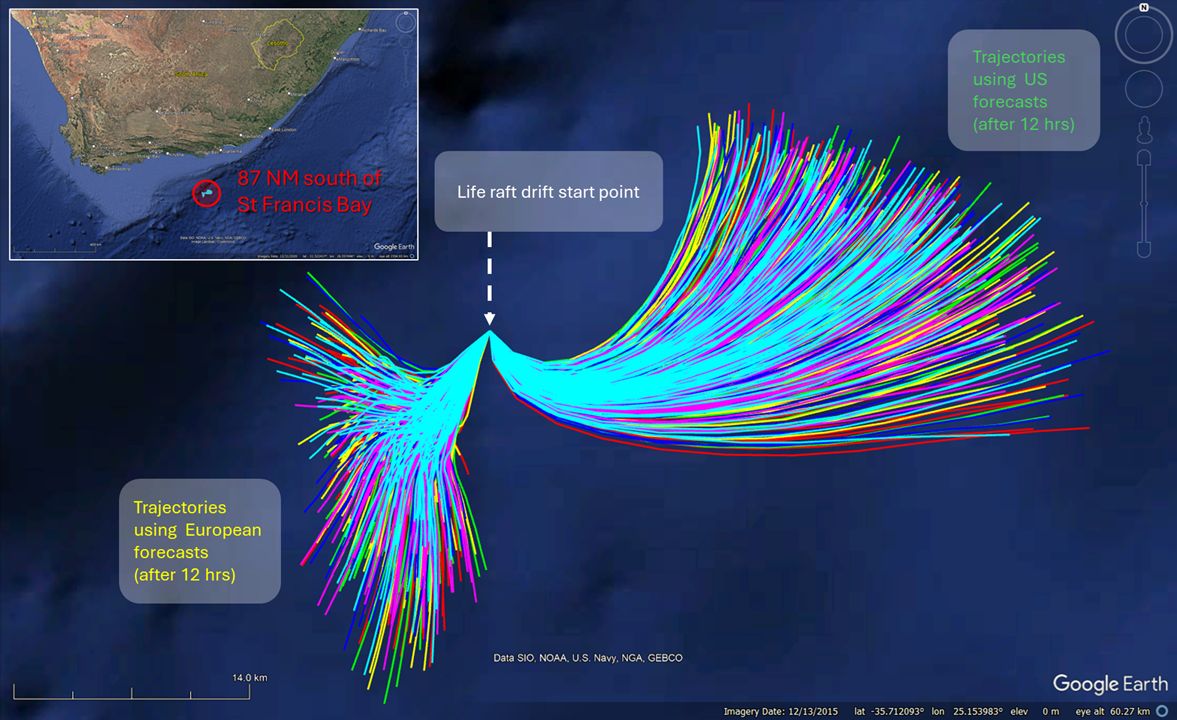
This wasn’t a bug – it was due to a difference in the timing and placement of an oceanic eddy which spun off the Agulhas Current, in the different forecasts.
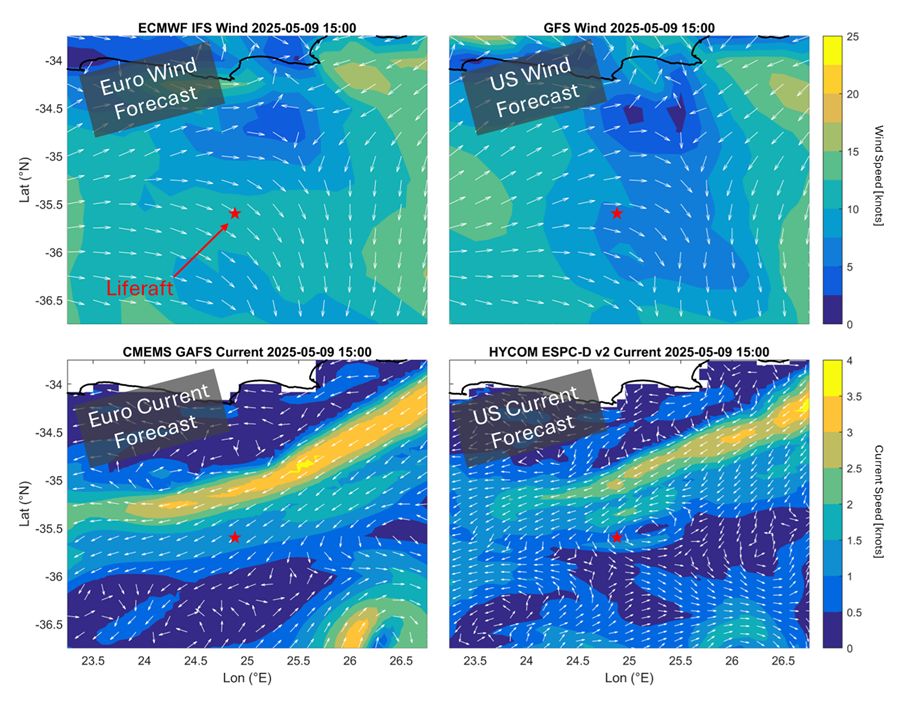
At first glance, the ocean current forecasts look very similar, but for many real-world applications, the devil is in the details, and this small discrepancy could have major implications.
Ocean modellers have long known about this specific challenge, and it’s incredibly difficult to get these forecasts right. This is just a (single) example of why it’s (still) important to keep trying to improve them.