Short-term wave prediction with machine learning, but without pretending the wind forecast is perfect...
If you are interested in the short-term prediction of ocean waves, take a look at my colleague Zheng Ren's new paper in Applied Ocean Research. The paper is open access, and addresses a problem which is both highly practical and often overlooked in data-driven forecasting: the fact that the wind fields used to force wave forecasts are themselves uncertain. The study, titled "Noise-augmented and probabilistic deep learning for significant wave height forecasting with attention-based LSTM models", was published in 2026 in Applied Ocean Research.
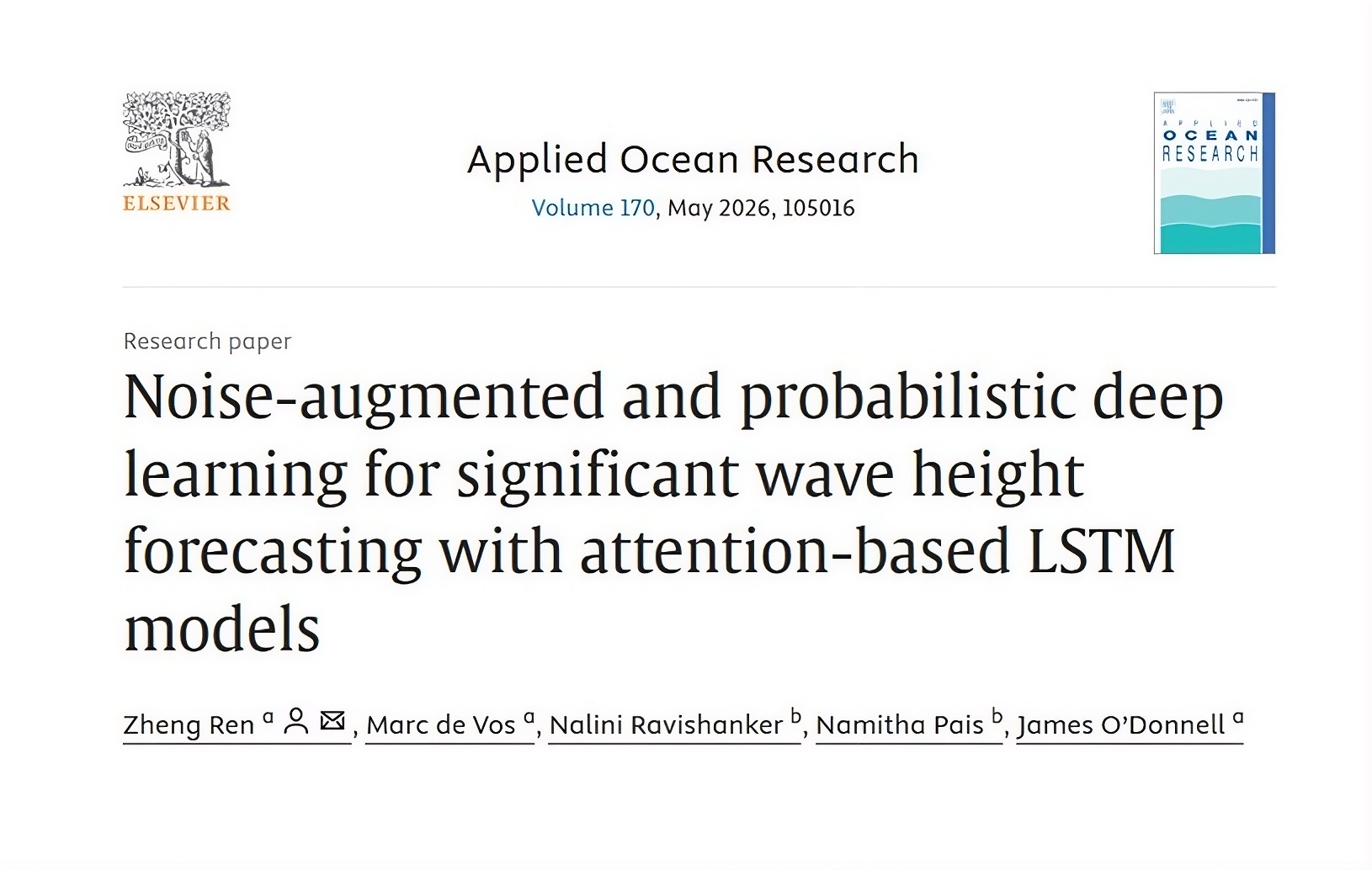
There is no shortage of recent studies applying machine learning to wave prediction. What I like about this paper is that it does not do so naively. Rather than assuming that forecast inputs are clean and exact, Zheng examined the benefit of deliberately training the models with random noise, intended to represent the inevitable error in the wind forecasts used as forcing. That is a more physically honest framing of the problem, because in operational settings we are almost never trying to predict waves from perfect knowledge of the atmosphere.
The paper focuses on short-term, multistep forecasting of significant wave height, and combines deep-learning tools with probabilistic prediction so that the output is not only a single deterministic forecast, but also an estimate of forecast uncertainty. In other words, it is interested not just in what the waves are most likely to do, but in how confident we should be in that prediction. That matters for offshore operations, coastal engineering, marine renewable energy, and navigation, where the consequences of underestimating sea state can be significant.
More broadly, the paper is a useful reminder that better prediction does not always come from adding a more complicated algorithm. Sometimes it comes from representing the real structure of the uncertainty more carefully. In this case, that means recognising that errors in wind forecasts propagate into errors in wave forecasts, and then building that reality into the training strategy rather than treating it as an afterthought.
This way of thinking is likely to become increasingly important as machine learning continues to find applications in metocean forecasting. The real challenge is not merely to produce a model which performs well in an idealised retrospective test, but to produce one which remains useful in the messier context of real-world forecasting systems, where the inputs are uncertain, the stakes are practical, and users need more than a single number.
Congratulations to Zheng Ren, UConn CIRCA director Prof James O'Donnell, and the other co-authors on a very interesting contribution.
The paper is available here: Noise-augmented and probabilistic deep learning for significant wave height forecasting with attention-based LSTM models .